
Ferritin Levels for Women: New Iron Deficiency Guidelines and How to Read Your Iron Labs
Oct 08, 2026In 2026 the American Society of Hematology (ASH) raised the ferritin cutoff for diagnosing iron deficiency. For most adults, including menstruating and pregnant women, it's now 30 ng/mL, and for women with heavy periods 50 ng/mL may be appropriate. If you've been told your iron is "fine" with a ferritin in the teens or twenties, it's worth a second look. Below is what changed, how to read your CBC and iron panel, which tests to ask for, how to prep for your draw and what to monitor.
Written by Sarah Bishop, MS Exercise Science, Functional Health Coach
I've written before about why iron can stay low and what that feels like. (If you missed it, start here: Why Your Iron Is Still Low (Even Though You're Taking Supplements). That post was about what happens upstream: absorption, inflammation, copper and the iron recycling system.
This one is about getting identified in the first place.
For years, plenty of women have walked out of an appointment with fatigue, hair shedding and a ferritin of 18, and been told their labs look normal. According to the lab's reference range, they were (more on that below). Under the new guidelines, that result is iron deficiency. I was glad to see this update, and I want you to know exactly what changed and how to use it to advocate for yourself or your clients.
What changed in the new ASH guidelines?
The biggest shift is how "normal" gets defined. Most lab reference ranges are built from the middle 95% of a population, and they show us the range where disease is absent. Iron deficiency affects an estimated 14% of adults and 40% of females of reproductive age, which means plenty of iron-deficient women have landed right inside that "normal" range.
The update replaces that statistical range with a cutoff based on where iron deficiency actually shows up. For most adults, including menstruating and pregnant women, that cutoff is now a ferritin of 30 ng/mL.
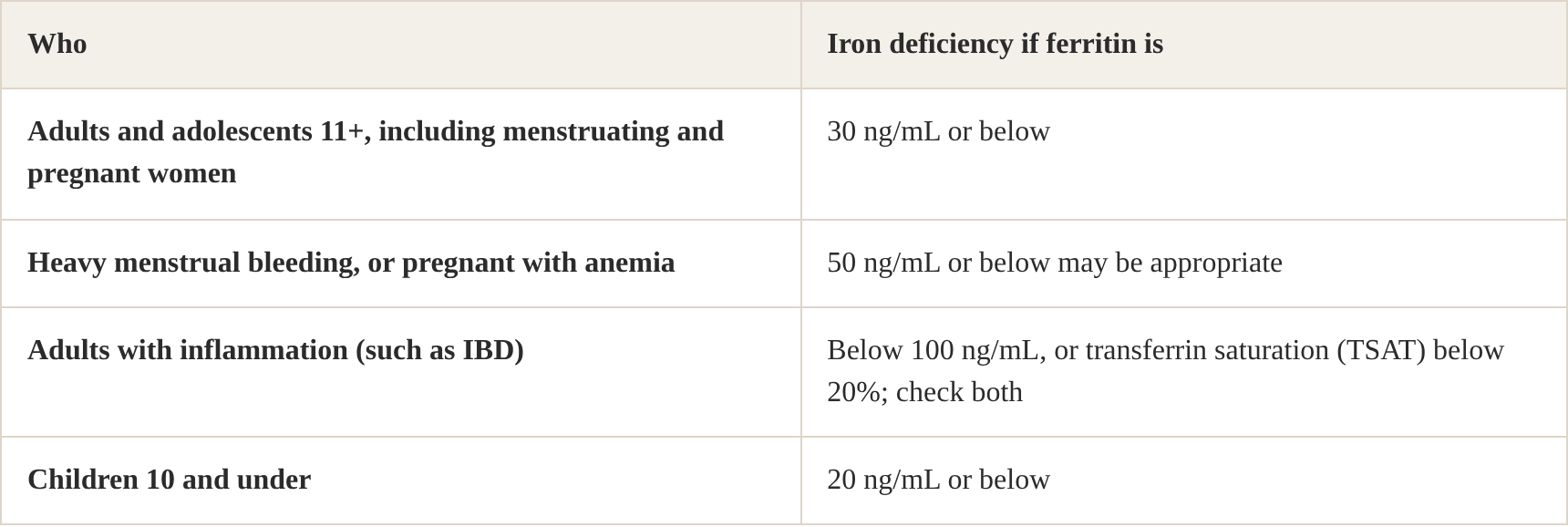
The jump from the long-used 15 ng/mL to 30 catches deficiency sooner in more people. In ASH's evidence review, a cutoff of 15 caught only 41% of adults with iron deficiency confirmed by bone marrow. A cutoff of 30ng/mL caught 67%, and 50 ng/mL caught 89% I'm going to pause on that last number.
50 ng/mLisn’t the diagnostic line for everyone because it also flags more women who aren’t deficient, which can lead to iron or treatment they don’t need. That trade-off is where I'm careful. Reference ranges come from population averages and don't always reflect someone in a thriving or high-performing state, which is what we want for ourselves and our clients. Sports research treats active women as a higher-risk group whose iron deserves closer monitoring . So alongside the diagnostic cutoff, I use a tighter working range to spot early imbalances and track direction before symptoms show up.
If you have past ferritin results, compare them against the table above. And if you're dealing with weakness, fatigue, trouble concentrating, a racing heart, headaches, pale skin or shortness of breath, ask for a full iron panel at your next draw.
One more thing worth knowing: ASH is calling on labs to flag a ferritin of 30 or below as abnormal. Until your lab makes that change, a ferritin of 22 can still come back with no flag at all.
Iron deficiency vs. iron deficiency anemia: a quick refresher
Iron deficiency means your stores are depleted. Iron deficiency anemia (IDA) is the later stage, when there isn't enough iron to make normal red blood cells and hemoglobin drops (below 12 g/dL for most women). You can be iron deficient for months with a completely normal CBC, which is exactly the gap these guidelines are trying to close.
It helps to think of it Iron deficiency in stages:
- Depleted stores. Ferritin drops while everything else looks normal. Symptoms can already show up here.
- Iron-deficient red cell production. Transferrin saturation drops, TIBC rises and RDW may start creeping up.
- Iron deficiency anemia. Hemoglobin falls and red blood cells get smaller (low MCV) and paler (low MCH and MCHC).
Stages 1 and 2 are where active women tend to get missed, because the CBC still looks fine. If you want the deeper dive on anemia types and why IDA is a symptom to investigate, I cover it in my first iron post.
How to think about your CBC and iron panel
When most women get their iron "checked," what they actually got was a complete blood count (CBC), sometimes with a serum iron. Both are useful, and neither gives you the complete picture.
Your CBC describes your red blood cells and gives insight into oxygen delivery, immune status, inflammation, nutrient sufficiency and bone marrow activity. Hemoglobin is the oxygen-carrying protein inside red cells, and it's the last marker to drop. When it's low, you're already anemic.
A full iron panel (ferritin included) tells you about the iron itself and catches deficiencies and inadequacies earlier . Ferritin reflects your stores, serum iron is what's circulating right now, and transferrin saturation and TIBC show how well your transport system is moving it. Because ferritin rises with inflammation, I always want hs-CRP on the same draw.
The CBC provides insight into oxygen delivery, immune status, inflammation, nutrient sufficiency, and bone marrow activity. Patterns across RBC indices (MCV, MCH,
MCHC, RDW) help differentiate types of anemia and nutrient deficiencies,
For an active woman, I like to see ferritin between 50 and 100 ng/mL and serum iron between 70 and 130 µg/dL. That's my working range for training, cycles and real life; the diagnosis stays with your provider. A ferritin that clears a lab reference range cutoff may be a thin cushion for a woman heading into a race block, dealing with a heavy cycle, or hair shedding. When ferritin runs well above that range, I look for inflammation
None of these numbers mean much in isolation. What tells the story is how they move together, and how they move against your own baseline.
Why ferritin alone can't tell you the whole story
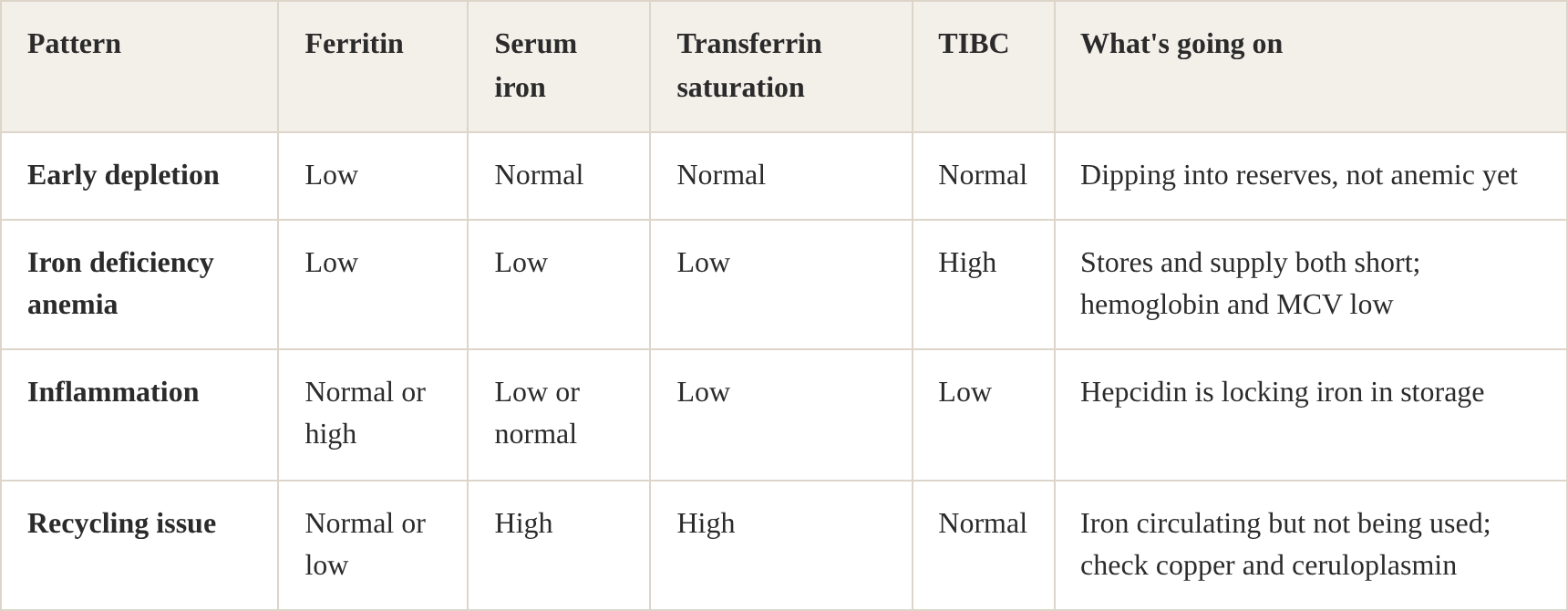
Ferritin is your storage marker, and it also rises with inflammation. Infection, a flare of a chronic condition like IBD, or a hard few weeks of training can all push it up . So a ferritin of 60 in someone with active inflammation can hide a real deficiency. That's why I always suggest hs-CRP alongside ferritin, and why no single biomarker gets interpreted in isolation. I'll write more on inflammation markers in a future post.
It can go the other direction too. In my last iron post I walked through the recycling problem, where serum iron and transferrin saturation are high but ferritin is normal or low because copper and ceruloplasmin aren't moving iron where it needs to go. More iron in that case just adds to the pile.
Functional ranges are my working ranges for active women, not diagnostic criteria. Your provider makes the diagnosis.
What tests should I ask for?
If you're dealing with fatigue, hair shedding, breathlessness on easy runs, restless legs or cold hands and feet, ask for more than a CBC.
The core:
- Full iron panel: ferritin, serum iron, TIBC and transferrin saturation
- CBC with red cell indices including : hemoglobin, MCV, MCH, MCHC (these help differentiate between b12/folate anemia/deficiency and Iron deficiency /Anemia .. they will be high in the former and low in the latter
- hs-CRP, so you know whether inflammation is inflating your ferritin
Worth adding, depending on your history:
- B12 and folate, since a deficiency in either can mask the small-cell pattern of iron deficiency
- Serum copper, ceruloplasmin and zinc if you've supplemented long-term or your iron isn't responding
- CMP and a full thyroid panel, because the symptoms of hypothyroid overlap heavily
And remember, never test just to test. Go in with a question you want answered and a provider to help you interpret the results.
How to prep for labs so your numbers mean something
These come straight from the blood work guidelines we give every Fortify health client:
- Draw no later than 9 am, after a 10 to 12 hour fast. Don't fast longer than 14 hours.
- No supplements the morning of your draw. Resume them after.
- No caffeine within 8 hours. Drink at least 1 liter of plain water beforehand and skip electrolyte drinks that morning.
- No resistance training, HIIT, long endurance sessions or heavy manual labor for at least 24 hours before. Light walking is fine.
- Avoid alcohol for at least 48 to 72 hours. Five to 7 days gives you cleaner inflammatory markers.
- Recent illness, infection or vaccination can raise ferritin and inflammatory markers, so disclose it. The same goes for any steroid, including topical, inhaled and joint injections; ideally draw 6 to 8 weeks after finishing a course.
- Use the same lab when you can, since reference ranges vary.
Don't wait for anemia
Iron deficiency without anemia still deserves attention, especially when you have symptoms or risk factors like heavy periods or high training volume. Waiting for hemoglobin to drop means waiting for the last stage.
Just as important is finding the cause. Supplementing without asking why iron dropped sets you up to repeat the cycle. With heavy menstrual bleeding, that means a gynecologic workup, because if the bleeding isn't managed, iron stores won't improve much no matter what you take.
Treating early and digging into the cause is how I've always approached iron. If you want to see what that looks like in practice, from diet to supplement choices to supporting the body as a system, start with Why Your Iron Is Still Low. And discus with your provider decisions about dose, form or IV iron
What to monitor once you start supporting iron
An intervention without a follow-up is just a guess. Once you have a baseline and a plan, keep an eye on:
- Symptoms and biofeedback. Energy, training quality, heart rate at easy paces, sleep, hair shedding, restless legs and period flow often move before the labs do.
- A 12-week retest. Recheck ferritin, hemoglobin and TSAT 12 weeks after starting iron, using the same prep and cycle timing as your first draw.
- Your trend against your own baseline, not only whether you landed inside the range.
Long-term supplementing without retesting carries its own risk. I've seen a supplement protocol nobody had reviewed in a year end up being part of the problem (zinc depleting copper, in that case).
How I educate my clients on their iron labs
When I review lab work with a client, one of the first things I explain is that a biomarker can sit inside the population reference range and still be abnormal for her. That happens when it has moved a lot from her own baseline, or when it doesn't fit with the rest of her health and training.
Take a client with endometriosis and heavy bleeding. She's losing iron every month, so a ferritin in the 30s is already a red flag for her even if the lab doesn't flag it. Under the new guidelines she falls into the 50 ng/mL group, which finally matches what I'd been watching for.
With a client who has IBD, I may see a ferritin that looks great on paper. Cross-checking hs-CRP and her other inflammatory markers tells me how much of that number is coming from her condition, and whether her body still has iron it can actually use.
And biomarkers should never be used to bypass an athlete's story. Her symptoms, training load, nutrition, sleep, emotional and life stress, travel, where she was in her cycle at the draw and any recent illness all shape how I read that panel. A lab result is one piece of the reasoning, and I treat it that way.
The bottom line
The new cutoffs line up with what many of us have been seeing in practice: women with a ferritin in the 20s and 30s feel it, train worse for it and deserve to be identified. If you've been told your iron is fine, pull your last labs, check your ferritin against the table above and look at transferrin saturation and hs-CRP alongside it. If you're already supplementing and your numbers won't budge, read Why Your Iron Is Still Low (Even Though You're Taking Supplements) next.
If you want help connecting your labs to your symptoms, training and history, book a 1-on-1 strategy session. Coaches and health professionals, this is exactly the kind of case we work through together in mentorship.
This article is for educational purposes and reflects a functional health perspective. It is not medical advice and does not replace individualized care from your physician. Always work with a qualified provider to interpret your labs and decide on supplementation.
Sources
- Powers JM, Lim MY, Achebe MO, et al. American Society of Hematology 2026 guidelines for diagnosis of iron deficiency. Blood Advances. 2026. doi:10.1182/bloodadvances.2025015950
- American Society of Hematology. Diagnosis of Iron Deficiency: An Educational Slide Set. DeLoughery T, Van Doren L, Zeller MP. 2026. hematology.org/IDA-guidelines
- American Society of Hematology. 2026 ASH Guidelines on Diagnosis of Iron Deficiency: Implementation Tool. 2026.
- American Society of Hematology. ASH Draft Recommendations for Treatment of Iron Deficiency and Iron Deficiency Anemia. Draft for public comment, October 5 to November 5, 2026.
- Sim M, et al. “Iron considerations for the athlete: a narrative review.” Eur J Appl Physiol. 2019;119(7):1463-1478.
- eeling P, et al. “Athletic induced iron deficiency: new insights into the role of inflammation, cytokines and hormones.” Eur J Appl Physiol. 2008;103(4):381-391.